

If you ask almost anyone whether sleep matters, they'll say yes. But then the moment a new TV series or a late night out comes along, and sleep is usually the first thing to give. Part of the reason is that the cost of a short night is easy to feel the next morning but hard to picture over years.
I'm no exception. For a while now I've been trying to wake up early on a consistent schedule, but I often struggle to get to sleep on time. That leaves me choosing between a decent night's sleep and keeping the wake-up time I'm trying to stick to.
I recently came across a study that makes that long-term cost easier to picture, and I wanted to share it here because it contains some interesting data that most people will likely never see. Titled Accelerometer-derived real-world sleep stages and risk of incident diseases, it was published in September 2026 in PLOS Medicine, a peer-reviewed medical journal. Researchers from Peking University and Capital Medical University in Beijing measured the sleep of 95,559 people in the UK using wrist-worn sensors, then followed them for nearly nine years to see which diseases they went on to develop. They checked sleep against 1,049 different health conditions, which makes it one of the broadest looks yet at how sleep connects to long-term health.
In short, the study found that adults who slept under five hours a night had a higher risk of dozens of conditions compared with those sleeping six to eight hours, including about 2.6 times the risk of dementia and 1.7 times the risk of heart failure. More REM and deep sleep were linked to a lower risk of many diseases, while irregular sleep was linked to a higher risk of anxiety and depression. For most of the conditions the researchers highlighted, the lowest risk sat at around seven to seven and a half hours of sleep a night. Because the study is observational, it shows links between sleep and disease rather than proof that one causes the other.
What made this one stand out to me is how the sleep was measured. Most large studies on sleep and health rely on people estimating their own sleep in a questionnaire, and research has shown those estimates often don't match measured sleep very well. Studies linking device-measured sleep stages to a wide range of diseases have tended to be much smaller. One of the best known, from the US All of Us Research Program, followed around 6,800 Fitbit users. This study measured sleep with a device in 95,559 people, more than 14 times as many, and checked it against more than a thousand conditions. The authors describe it as the most comprehensive map to date of how measured sleep relates to disease, and having read it, I think that's a fair description.
In this article I'll walk through what they found, what it means in plain terms, and where the findings need some caution. Before we go on, please note that I'm not a doctor and nothing here is medical advice. If you're worried about your sleep or your health, your GP is the right first stop.
What did the researchers actually do?
The data comes from the UK Biobank, one of the largest health research projects in the world. Between 2006 and 2010 it recruited just over 500,000 adults aged 40 to 69 through 22 assessment centres across England, Scotland and Wales. Volunteers answered detailed questions about their health and lifestyle, gave biological samples, and agreed for their health to be followed through their medical records over the long term.
Approved researchers anywhere in the world can apply to use this data, which is why the UK Biobank sits behind so many large health studies. The combination of size and long follow-up is what makes it valuable here. You can only see whether sleep habits are linked to diseases like dementia if you can track people for years after their sleep is measured.
Between 2013 and 2015, more than 100,000 of these volunteers wore a wrist sensor called an accelerometer for a week. An accelerometer only measures movement, so the researchers ran the data through an AI model called SleepNet, which was trained on more than 1,100 nights of lab sleep studies to estimate sleep stages from movement patterns. After removing incomplete data, 95,559 people remained, with an average age of 56 when they first joined the Biobank.
From that week of data, the team pulled out six measures: total sleep time, REM sleep, deep sleep, light sleep, time spent awake after first falling asleep, and how much sleep varied from one night to the next. They then linked each person to their hospital records up to April 2024 and checked each sleep measure against every condition that came up often enough to analyse.
When you test over a thousand conditions, some results will look meaningful by pure chance, so the researchers applied a strict statistical correction to filter those out. After that, 156 links between sleep and disease remained. The analysis also adjusted for a long list of other factors that affect health, including age, sex, deprivation, BMI, smoking, alcohol, exercise, screen time, air pollution and night-time noise.
Does short sleep increase your risk of disease?
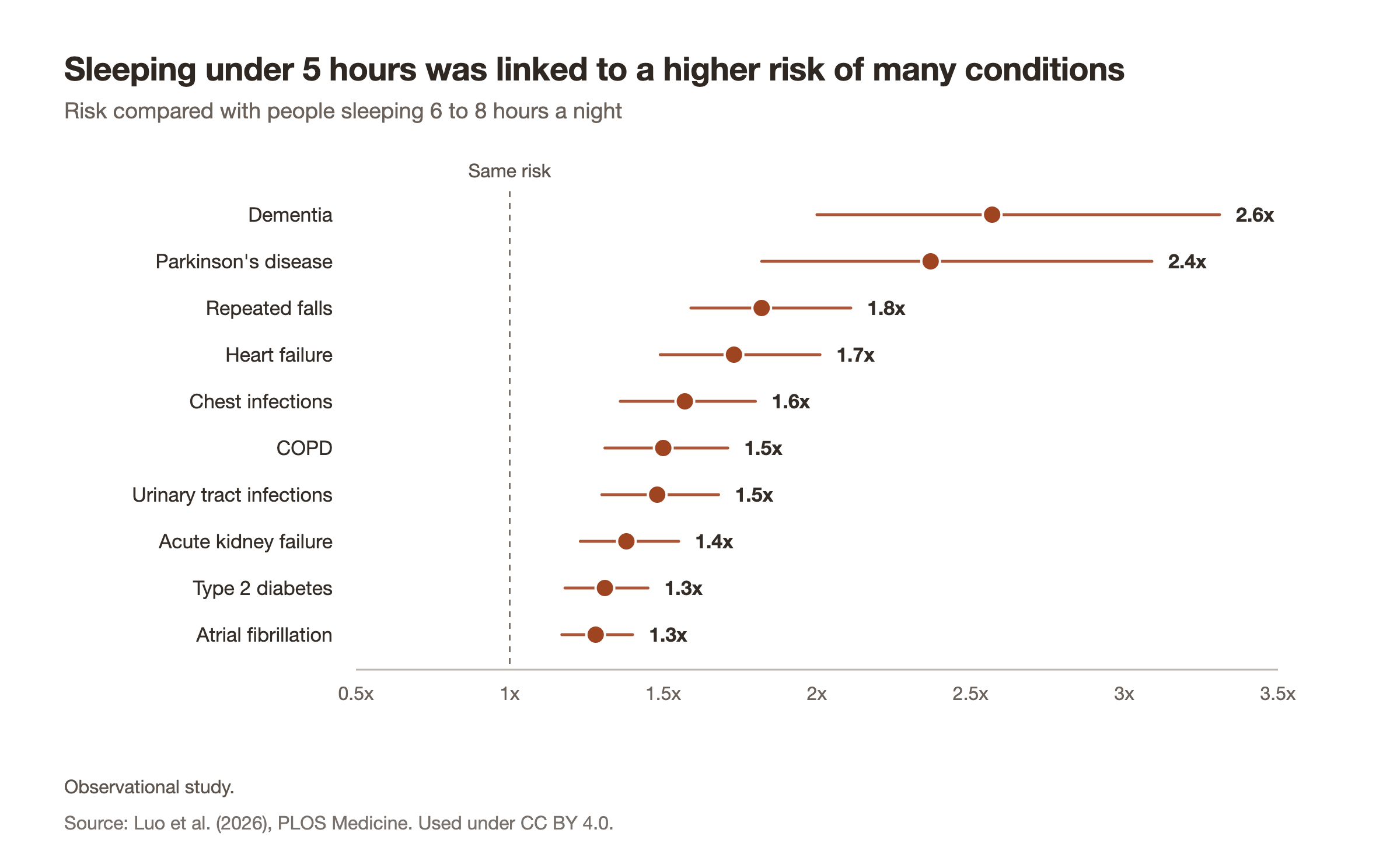
The most consistent result in the study was about short sleep. When the researchers grouped people by how long they slept on average, those averaging under five hours a night accounted for 37 of the 41 significant links to higher disease risk, compared with people sleeping six to eight hours.
Those groups were based on each person's average sleep across the week they wore the sensor, which the researchers treated as a snapshot of their normal sleep habits. That distinction matters, and this study isn't saying that one bad night, or even one bad week, raises your risk of dementia. I had a good example of this last week. I travelled to Korea, and between two night flights and changing hotel rooms (and therefore beds) partway through, I slept less than six hours almost every night of the trip. On paper, that week would have put me in one of this study's higher-risk groups. In reality it was a bad week, not a habit, and that isn't what this research is measuring. The question it asks is how people's usual sleep relates to their health over the following nine years.
The researchers also checked whether a single week was a fair reflection of normal sleep. Around 3,000 of the volunteers wore the sensor again a few years later, and their sleep measures were reasonably consistent between the two weeks. In other words, the people sleeping under five hours in this study were most likely people who regularly slept that little.
That said, a week is still a short window. From what we've seen with Leep, the long-term trend in someone's sleep tells you more than any single week, and I wouldn't judge my own sleep on seven nights of data. Across 95,000 people, though, a week per person still adds up to a valuable picture, because one-off weeks like my Korea trip tend to even out across a population that size.
The conditions involved span most of the body. Compared with the six to eight hour group, people sleeping under five hours had about 2.6 times the risk of dementia, 2.4 times the risk of Parkinson's disease and 1.7 times the risk of heart failure. Their risk of COPD and chest infections was around 1.5 times higher, and type 2 diabetes, kidney failure, atrial fibrillation, repeated falls and urinary tract infections all appeared on the list too.
To be clear, having two and a half times the risk of dementia doesn't mean most short sleepers develop dementia. It means that over the nine years, the rate of new cases among them was about two and a half times that of people sleeping six to eight hours.
The five to six hour group wasn't in the clear either. Those people had a higher risk of repeated falls and lobar pneumonia (a type of lung infection) than the six to eight hour group, which suggests the risk doesn't only appear at the extreme end.
Do REM and deep sleep affect long-term health?
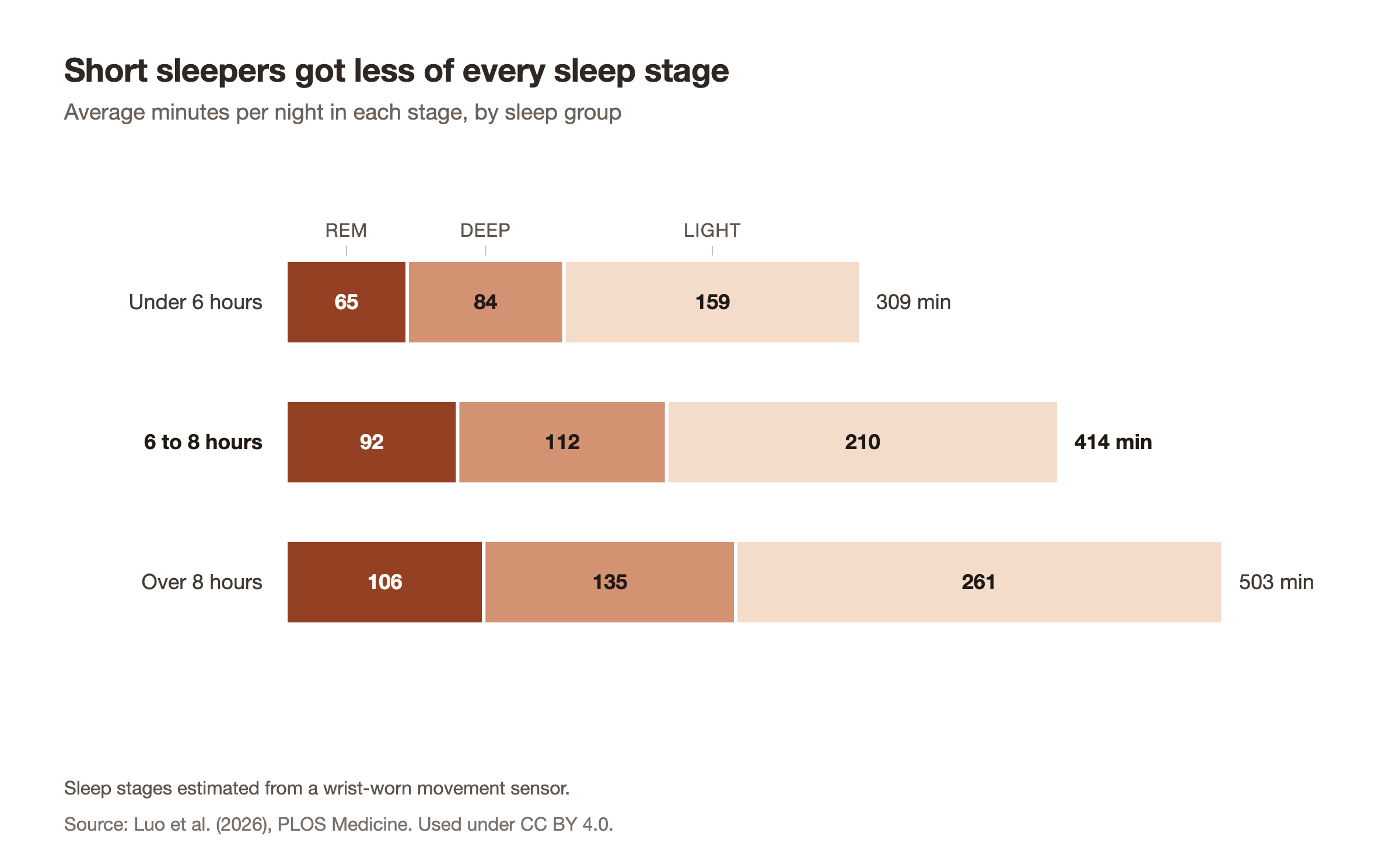
Sleep isn't one continuous state. Through the night you cycle through light sleep, deep sleep (also called slow-wave sleep) and REM sleep, the stage most associated with dreaming. Deep sleep is when much of the body's physical recovery takes place, while REM plays a role in memory and emotional processing. Both can be squeezed by everyday habits, and alcohol in particular is known for cutting into REM sleep.
REM sleep produced the largest set of results in the whole study. More REM was linked to a lower risk of 83 conditions across 12 categories of disease. For every extra 48 minutes or so of REM, the risk of heart failure was 26% lower, atrial fibrillation 17% lower and dementia 46% lower. The strongest associations were with neurological conditions, including parkinsonism, multiple sclerosis and Alzheimer's disease, although I'd treat those with some caution for reasons I'll cover further down.
Deep sleep showed a smaller version of the same pattern. More of it was linked to a lower risk of seven conditions, including type 2 diabetes, depression, sleep apnoea and Parkinson's disease.
Light sleep is more complicated. More light sleep in total was linked to a lower risk of heart failure, which probably reflects the fact that people who sleep longer get more of every stage. But when the researchers looked at light sleep as a share of the night, a higher proportion was linked to a higher risk of 28 conditions. In other words, a night made up mostly of light sleep appears to be a lower quality night, even when it's a long one.
Is irregular sleep bad for your health?
Two of the six measures captured how broken up and irregular people's sleep was. The first was time spent awake after first falling asleep. Brief wake-ups during the night are often normal, so this measure is about the total time spent awake rather than the odd brief stir. The second was sleep irregularity, meaning how much a person's total sleep changed from one night to the next.
Both were linked to worse outcomes, mostly in mental health. A more irregular sleep pattern was associated with a 23% higher risk of anxiety disorders and a 26% higher risk of depression. More time awake during the night was linked to a higher risk of alcohol misuse and substance dependence, as well as osteoarthritis. Poor sleep and low mood tend to feed into each other, which we've looked at in more detail before. Anxiety and depression can also disrupt sleep in the first place, so these links likely run in both directions.
The people sleeping six to eight hours also slept more regularly than short sleepers. Their sleep varied by about 79 minutes from night to night on average, compared with around 124 minutes for people sleeping under six hours. This fits with a 2023 consensus statement from the National Sleep Foundation arguing that regular sleep matters for health in its own right, separate from how long you sleep.
This is the part of the study that hit closest to home for me. In a normal week, my sleep varies by only about 30 minutes from night to night, well below even the regular sleepers in this study. When I do get to bed late, it tends to be late by a similar amount each night, so my sleep runs a little short rather than swinging around. During the Korea trip, that jumped to around three hours. My ring and the researchers may not calculate this in exactly the same way, so it isn't a perfect comparison, but the gap between a normal week and that one shows how quickly travel can undo a routine that otherwise holds up well.
How much sleep do you need to lower your disease risk?
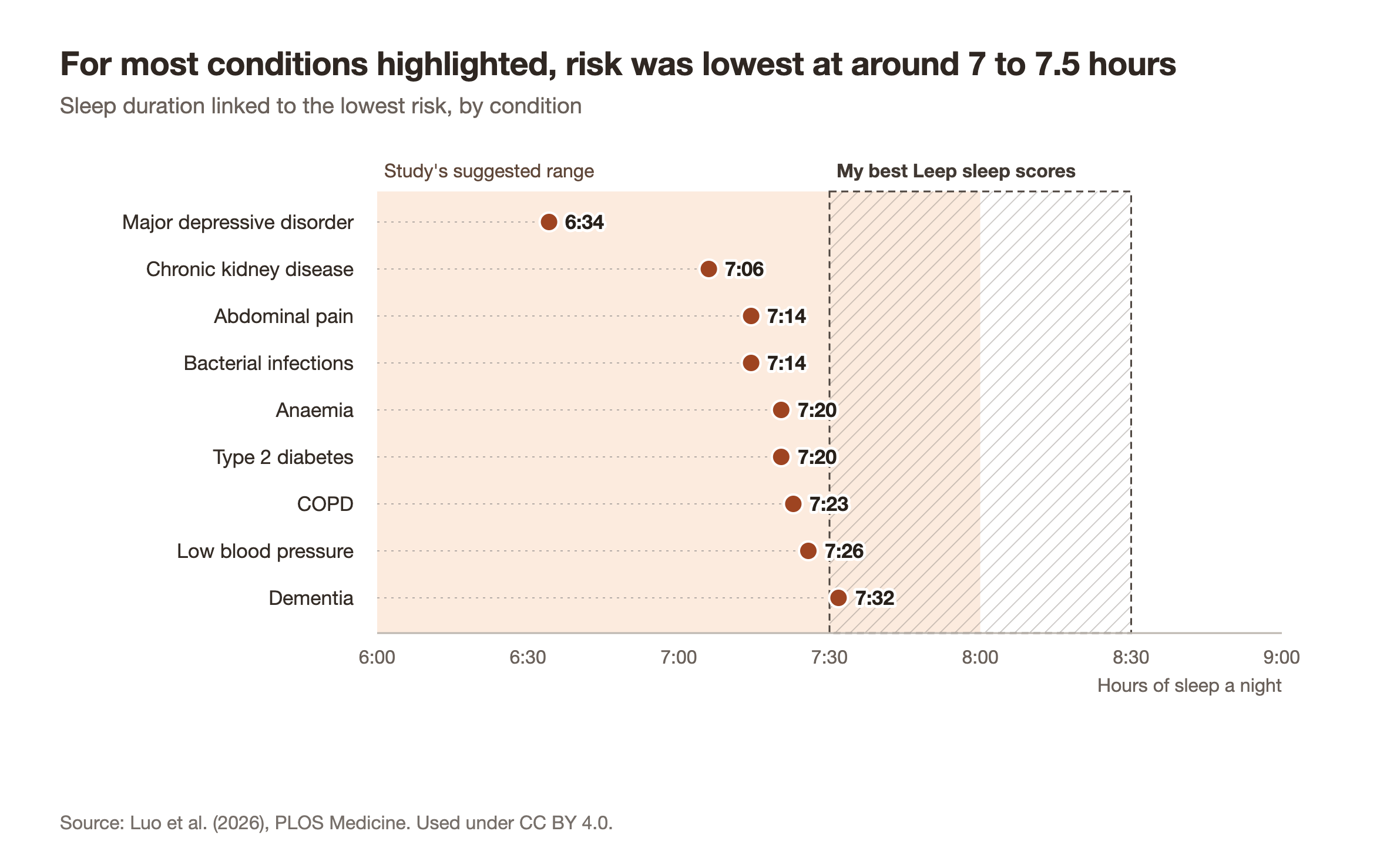
The researchers also looked for the amount of sleep linked to the lowest risk for each condition. For 86 conditions the relationship wasn't a straight line, and for 69 of those the lowest-risk point fell between six and eight hours. For most of the conditions the researchers highlighted, it sat at around seven to seven and a half hours: 7.34 hours for type 2 diabetes, 7.38 for COPD, 7.53 for dementia and 7.10 for chronic kidney disease.
Sleeping more than eight hours was linked to far fewer problems than sleeping too little. The main exception was depression, where people sleeping eight to nine hours had a 55% higher risk. The authors point out that this is likely at least partly the other way round. Sleeping more than usual is a known early symptom of depression, so the condition may be driving the long sleep rather than the reverse.
Based on these results, the authors suggest the healthiest range for middle-aged and older adults may be six to eight hours, a little shorter than the National Sleep Foundation's recommendation of seven to nine hours for most adults (and seven to eight for over-65s). I wouldn't move your bedtime based on that just yet. The study's sleep times come from a wrist sensor that also counted naps, and in validation testing it was out by around 48 minutes compared with a lab sleep study. Most sleep guidelines are built on research where people reported their own sleep, which is measured in a different way again. Six to eight hours on this device isn't directly comparable to six to eight hours in those studies, so I'd still treat the existing guideline as the target.
Personally, the six to eight hour figure feels a little low. Looking back through my Leep data, my best sleep scores almost always come from nights of between seven and a half and eight and a half hours. Much less or much more than that, and my score drops off noticeably. That's one person's data, and a sleep score isn't the same thing as long-term disease risk, but it lines up better with the study's detail than with its headline. For most of the conditions the researchers highlighted, the lowest-risk point sat at around seven to seven and a half hours, towards the top of the six to eight hour range rather than the middle.
What are the limitations of this sleep study?
This is a large and carefully run study, but it has limits, and the authors are open about most of them.
The first is that it shows association rather than cause. People who sleep poorly differ from good sleepers in plenty of ways, and while the researchers adjusted for a long list of factors, some differences will always slip through.
The second is that illness can change sleep years before it's diagnosed. Conditions like Parkinson's disease and dementia affect sleep and movement well before other symptoms are noticed. When the researchers excluded diagnoses made in the first two years after the sleep data was collected, only 95 of the 156 links held up. That suggests some of the results reflect disease affecting sleep, rather than sleep affecting disease. This is the main reason I'd be cautious about the REM results for neurological conditions, because a movement sensor estimating REM will also pick up early changes in how someone moves at night.
The third is the measurement itself. A wrist accelerometer only senses movement, so it estimates sleep stages indirectly. SleepNet's agreement with lab sleep studies was moderate, and it tended to underestimate REM sleep, so the authors describe their stage data as movement-based estimates rather than exact measurements.
Finally, health outcomes were tracked for nearly a decade after that one week of measurement, and only hospital diagnoses were counted. The volunteers were also healthier, wealthier and less ethnically diverse than the UK population as a whole, which may limit how well the results apply to everyone.
If I had one wish for the next version of this research, it would be longer tracking with devices that measure more than movement, so sleep stages are estimated from heart rate and temperature as well. The All of Us study shows that's possible with everyday wearables. The challenge is doing it with tens of thousands of people over many years.
None of this undoes the main message. Short sleep has been linked to poorer health for years, including in a meta-analysis of over 1.3 million people that tied it to a higher risk of early death. What this study adds is breadth, with the same pattern turning up across almost every system in the body.
What I'm taking from it
The clearest message from this study is also the least surprising one. Getting enough sleep, and getting it at roughly the same time each night, is linked to better health across almost every part of the body. The biggest gap in risk was between people sleeping under five hours and everyone else, which suggests the most useful step for most people is avoiding the very short nights rather than chasing a perfect one.
For me, this points to the start of the night rather than the end. My alarm already takes care of the wake-up time, so the hard part is getting to bed early enough to give myself a full night's sleep before it goes off. If that sounds familiar, evening light from screens and an afternoon coffee are two common reasons bedtime keeps drifting later.
The study also says something about sleep tracking. Every finding came from a basic wrist sensor that only measured movement, worn for a single week. That was enough to reveal clear patterns across 95,000 people, but it's a narrow window into any one person's sleep. A ring like Leep pairs movement with heart rate, HRV and skin temperature, and is worn every night, which gives you a much longer view of your own habits.
That longer view is what matters for the patterns this research highlights. A single short night tells you very little, and as we've covered before, one bad sleep score isn't worth worrying about. The useful signal is in the trend: how often you're dropping below six hours, how much your sleep shifts across the week, and whether a run of short nights is building into sleep debt. Those are the habits this study ties to long-term health, and they're the ones worth keeping an eye on.
If you'd like to know more about what a ring is measuring while you sleep, this breakdown of the Leep ring's sensors is a good next read.
