
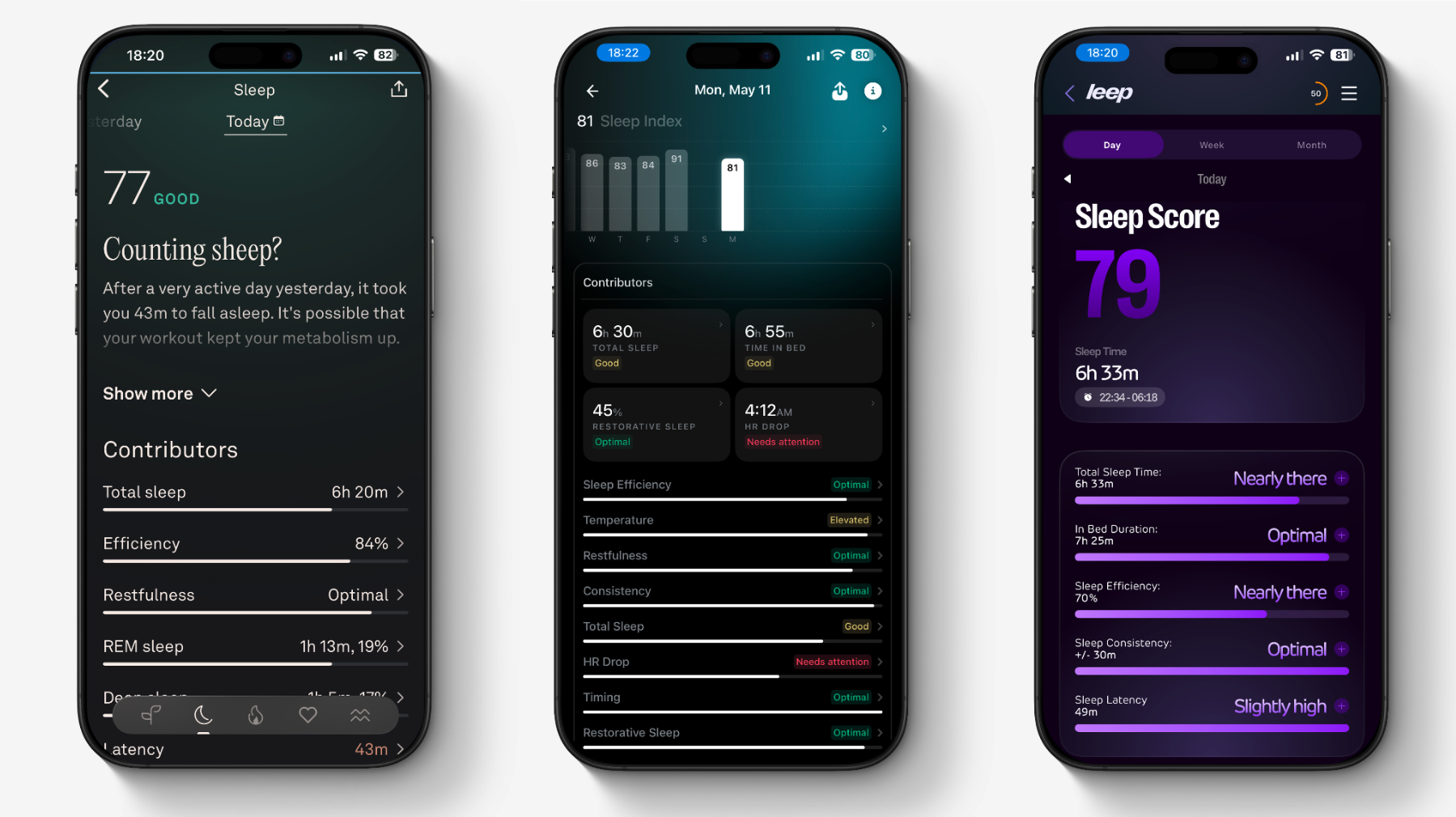

I remember the first time I woke up to a sleep score and just stared at it. A 71, or something close to that (it was so long ago that I can’t fully remember!). Fine, apparently. But I had absolutely no idea what had produced that number. Was it based on how long I slept? How deeply? Did my heart rate do something unusual at 3am? I'd worn my smart ring all night, and it had clearly been busy, but I had nothing to show for it except a two-digit number and a vague sense that I should probably go to bed earlier.
The score itself isn't the problem. A single number that summarises a night's sleep is useful as a quick morning check-in, in the same way a weather forecast is useful even if it doesn't tell you exactly how many millimetres of rain fell in your area. The problem is that most people, myself included at first, have no idea what's underneath it. And if you don't know what the tracker is actually measuring, you can't know whether to trust it, what to do when the number drops, or which parts of the data are worth paying attention to.
What follows describes the sensors inside the Leep Ring and the broad logic of how sleep scores are built, because sleep tracking companies don’t publish their full algorithms and it’s often impossible to know exactly what they are doing. Those sensors and that broad logic are similar across most serious sleep rings, watches and other trackers on the market. The research and studies referenced below tested a range of smart rings and wearables rather than the Leep Ring, and are not evidence of Leep’s own accuracy.
So here's what's actually happening inside that small band of titanium while you sleep. What the sensors are doing, why the finger turns out to be a surprisingly good place for them, what the software builds from all of that raw data, and which numbers are actually worth looking at in the morning.
What's actually inside the ring
There are four sensors inside the Leep Ring, and each one is doing something distinct while you sleep. They work together rather than independently, and the interesting stuff happens when the software starts combining their outputs. The four sensors are:
- A PPG sensor, which measures changes in blood volume with each heartbeat
- An accelerometer, which tracks physical movement across three axes
- A skin temperature sensor, which measures the surface temperature of your finger throughout the night
- An SpO2 sensor, which estimates blood oxygen saturation
Let's look at what each one actually tells you, and why it matters.
Heart rate and HRV
Let’s first discuss the PPG sensor and why the parameters its monitoring are important. From this single sensor, the ring extracts two things that matter: your heart rate and your heart rate variability.
Heart rate during sleep is relatively straightforward. Your resting heart rate drops as you fall into deeper sleep, which is a sign your cardiovascular system is recovering. A lower resting heart rate over the long term is generally associated with better cardiovascular health. A sudden spike on a particular night, when you haven't exercised heavily, often means your body is fighting something off before you've noticed any symptoms.
Heart rate variability is the more interesting metric, and the one that sleep researchers tend to pay the most attention to. HRV measures the variation in time between each heartbeat. Counterintuitively, more variation is better. A heart that beats with rigid, metronome-like precision is actually a sign of stress. A heart whose timing fluctuates slightly and naturally reflects a nervous system that is relaxed, adaptable, and recovering well. Research has found that higher HRV is associated with better self-reported sleep quality, lower fatigue, and reduced stress, and a 2017 study published in Sleep Medicine found that HRV measured during a short resting period functions as an independent marker of sleep efficiency and could serve as a clinical indicator of sleep quality.
Low HRV on a given night can indicate stress, illness, alcohol consumption, or insufficient recovery from exercise. Tracked over weeks, a gradual upward trend in your HRV is one of the cleaner signals that your sleep and recovery are genuinely improving.
Now, why does the ring measure this better than a watch? The short answer is physics. Research comparing finger and wrist PPG signals found that the dynamics recorded from the finger were significantly more similar to true HRV than those from the wrist, and the finger has been established in clinical research as the gold-standard location for PPG measurement. Studies suggest that PPG signals from the finger are generally cleaner and easier to analyse than those from the wrist, with wrist signals more likely to produce missing or unclear data points that make it harder to get an accurate read on blood flow. For a metric like HRV that depends on precise beat-to-beat timing, a cleaner signal is the difference between data you can act on and data that's directionally plausible at best.
Movement and sleep stages
The job of the accelerometer is easier to explain. It tracks physical movement across three axes throughout the night, so it knows not just that you moved, but roughly how much and in which direction. From that data, the ring can estimate when you fell asleep, how long you spent in each sleep stage, how restless you were, and how your sleep was distributed across the night.
Sleep stage detection is where people tend to have the most questions, and it's worth being honest about what consumer devices can and can't do here. The clinical gold standard for measuring sleep stages is polysomnography, a lab-based study that involves electrodes on your scalp, face, and legs, monitoring brain waves, eye movements, and muscle activity simultaneously. A ring on your finger is not doing that.
What it is doing is making a well-informed estimate, and those estimates have gotten meaningfully better as the algorithms have improved. Published validation studies of consumer smart rings show what this sensor combination can potentially achieve, although results from other devices should not be treated as validation of Leep itself. In one study published in the journal Sensors, using data from 440 nights across 106 individuals, researchers reported 94% accuracy distinguishing sleep from wake using accelerometer data alone, and 79% agreement across four sleep stages once heart rate and other physiological signals were added. That study tested a different wearable ring, not the Leep Ring. That four-stage figure covers light sleep, deep sleep, REM, and wake, and it reflects what happens when movement data is combined with the PPG sensor rather than used in isolation.
The accelerometer tells the ring you stopped moving, and the PPG sensor tells it what your heart was doing during that stillness. Together they give the software enough to work with. Research reviewing wearable sleep staging consistently finds that devices relying on accelerometer data alone are effective for distinguishing sleep from wake but fall short when it comes to identifying individual sleep stages, while those combining accelerometer and PPG data perform considerably better.
The honest caveat is that specific sleep stage percentages should be treated as directional rather than definitive. If your ring tells you that you got 45 minutes of deep sleep last night, that figure is a useful approximation, not a clinical measurement. What it's good at is showing you whether your deep sleep is consistently low across weeks, or whether last night was just an off night. The pattern is the point, not the number from any single night.
Skin temperature
The temperature sensor is the one most people pay the least attention to, and it's probably the most underrated of the four. Not because it tells you the most about your sleep directly, but because of what it can flag before you're consciously aware anything is wrong.
Your body temperature isn't static across the night. It drops as you fall asleep, reaches its lowest point in the early hours, then climbs again as you approach waking. This is part of your circadian rhythm, the internal biological clock that regulates sleep, hormones, metabolism, and a handful of other processes you mostly don't think about. Research into wearable circadian monitoring has found that skin temperature tracked overnight is one of the cleaner signals available for assessing how well that rhythm is functioning.
What the ring is tracking isn't the raw temperature number so much as how tonight compares to your personal baseline. That distinction matters because skin temperature varies between people, between environments, and across seasons. A reading of 34°C means almost nothing without context. A reading that's 0.8°C above your typical baseline on a night when you haven't drunk alcohol or exercised heavily is a different story.
The practical applications of this are more interesting than they might first appear. A study published in Nature Scientific Reports, which tracked physiological data from wearable devices during the Covid-19 pandemic, found that illness-associated rises in peripheral temperature were detectable via wearable sensors, and that the data supported the possibility of predicting illness onset before symptoms appeared. A separate proof-of-concept study found that continuous wearable temperature monitoring showed genuine value as an early warning system for infection detection.
In practice, this means that if you wake up to a lower sleep score on a morning when you feel fine, and the temperature data shows an overnight spike, there's a reasonable chance your body is already dealing with something you haven't noticed yet. Give it 24 hours and see. Alcohol does something similar, raising your skin temperature and disrupting your sleep architecture in ways the data captures even when the effect feels mild subjectively.
For women, skin temperature also tracks closely with the menstrual cycle. Body temperature rises after ovulation and stays slightly elevated through the luteal phase, which means your ring's baseline will shift across the month in a predictable pattern. Some people find this one of the more personally useful things the ring surfaces, because it contextualises changes in sleep quality and recovery that might otherwise seem random.
Blood oxygen
The SpO2 sensor is the most clinically significant of the four, and for most people on most nights, it will sit quietly in the background producing numbers that fall within a normal range and require no attention whatsoever. Normal blood oxygen saturation during sleep sits between 95 and 100%. If yours is consistently in that range, you can largely ignore this particular readout and focus on the metrics that tell you more about sleep quality day to day.
The reason it's there is for the minority of cases where something more significant is happening. Blood oxygen saturation drops when your breathing is disrupted during sleep, which is the defining characteristic of sleep apnoea. And sleep apnoea is far more common than most people realise. Estimates suggest that around 80% of cases go undiagnosed, meaning a significant portion of people who snore, feel unrested despite seemingly adequate sleep, or wake with headaches are living with a condition they've never had a name for.
A consumer sleep ring is not a diagnostic device. If your SpO2 is consistently dipping below 90% during sleep, the ring isn't going to tell you whether you have mild, moderate, or severe sleep apnoea, and it's not a substitute for a proper sleep study. What it can do is flag a pattern worth investigating. Research into wearable SpO2 monitoring has found that continuous overnight blood oxygen data carries diagnostic value for identifying sleep-disordered breathing, with studies demonstrating it can outperform other signals in sleep apnoea classification tasks.
Think of it as a useful first flag rather than a diagnosis. If the data looks unusual consistently across multiple nights, that's worth a conversation with a GP. The alternative, not tracking at all, means that pattern goes unnoticed entirely, which is the situation most people with undiagnosed sleep apnoea are currently in.
What to pay attention to in the morning
So that's what the ring is doing overnight. Four sensors, continuously collecting data, feeding into algorithms that produce a picture of your sleep by the time you wake up. The question is what to do with it.
The honest answer is: less than most people think, and over a longer timeframe than most apps encourage.
A single night's data is noisy. Your sleep varies naturally from night to night based on dozens of factors, many of which are outside your control. A late meal, a stressful conversation before bed, an unusually warm night, a slightly different bedtime. None of these make you a bad sleeper. Research consistently finds that patients are more likely to benefit from sleep tracking when the focus is on long-term patterns and daily functioning rather than nightly scores. A score from last Tuesday is not telling you much. A downward trend in HRV across three weeks is telling you something worth listening to.
The metrics that actually move the needle over time are fairly straightforward. Your HRV trend across weeks is the most sensitive indicator of how well your body is recovering from cumulative stress, whether that's physical, emotional, or illness-related. A sustained upward trend is a good sign. A gradual decline, without an obvious cause like increased training load, is worth paying attention to. Resting heart rate behaves similarly. A long-term downward drift is generally positive. A sudden spike on a night you haven't exercised is usually your body telling you something before you've noticed it consciously.
Sleep consistency is the other metric worth checking regularly, and it's the one people most often overlook in favour of flashier numbers. Going to bed and waking at roughly the same time each day is one of the most consistently supported behaviours in sleep research for improving sleep quality over time. Your ring will show you whether your timing is drifting, and if it is, that's usually more actionable information than knowing exactly how many minutes of REM sleep you got last night.
The sleep score itself is useful as a quick morning check-in, in the same way a weather forecast is useful without needing to understand the atmospheric modelling behind it. But if you find yourself waking up and immediately bracing for the number, or feeling like a bad night's score has coloured the whole morning before you've assessed how you actually feel, that's the tracker working against you rather than for you. The data is there to serve your sleep. If it's doing the opposite, step back, look at the weekly view, and let the trends do the talking.
