
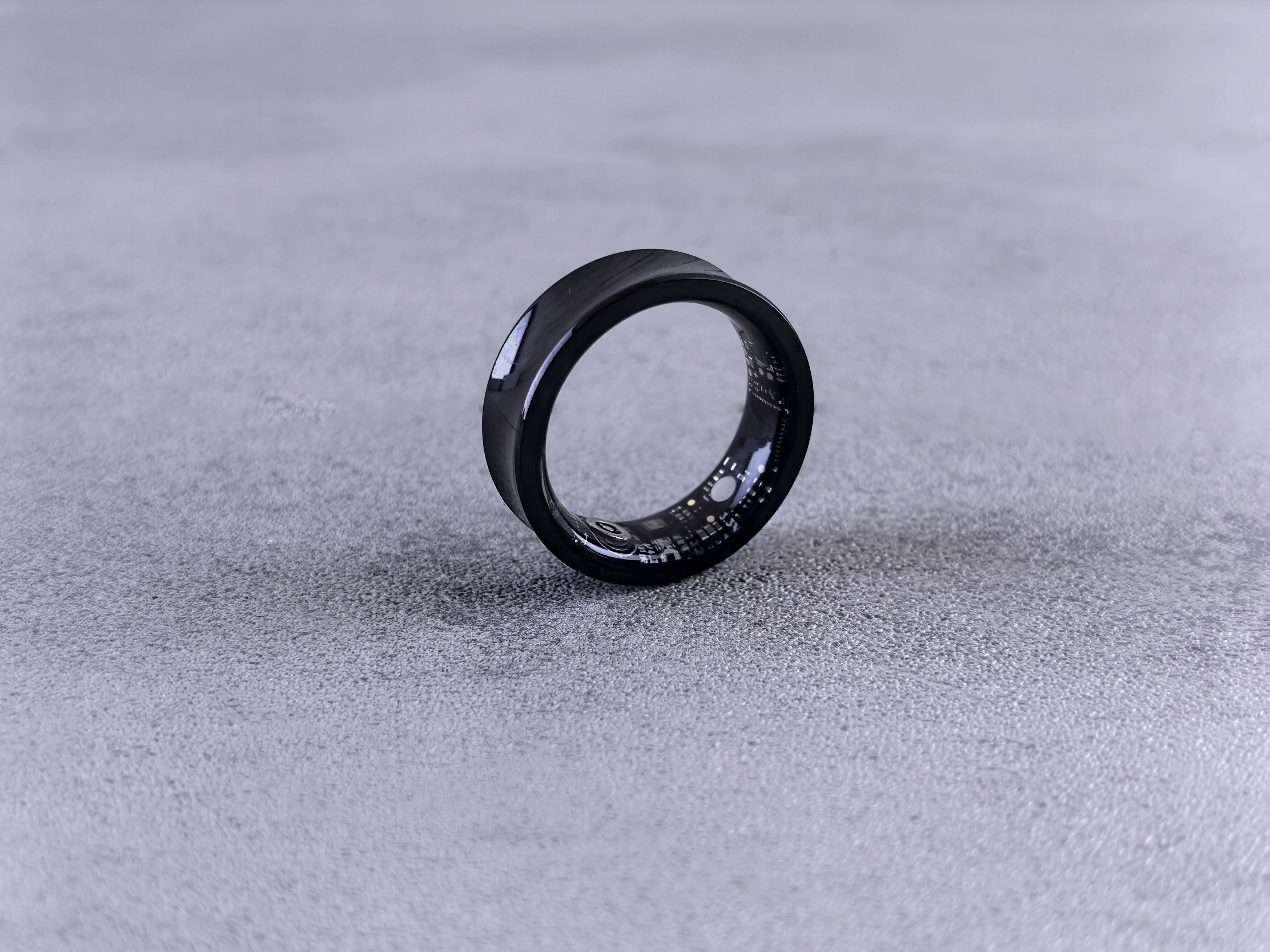

Unfortunately, it feels like everything is moving towards subscriptions these days. Music, movies, office software, and now, increasingly, the device on your wrist or finger. While some wearables are still a simple one-off purchase, others now charge an ongoing fee for full functionality, and a few won't work at all if you ever stop paying. Even within the 'one-off purchase' devices, more and more are trying to move, as one Reddit user put it, towards perpetual revenue streams.
That got me curious: once you add up 3 years of ownership - the upfront price plus any mandatory subscription - what do the most popular fitness trackers and smart wearables actually cost? At the end of the day, which one is the best deal? To answer that, I gathered current pricing for 16 popular wearables across 10 brands - smart rings, smartwatches, and fitness bands from Whoop, Oura, Samsung, Ultrahuman, RingConn, Apple, Garmin, Fitbit, Google, and Leep.
Personally, like many people, I try to steer clear of devices that need a subscription, so I was curious to see what that preference actually saves (or costs) over time. As you'll see, the gap is bigger than you might expect, but there are also a few surprises mixed in.
Now, before we begin, I want to make a few things clear.
- All prices are official US list prices for current models as of August 2026. Sales pricing and discounted devices are not considered as this makes comparisons extremely difficult and often unfair.
- Where a brand sells a range of products, I've included its entry-level and mid-range options. For example, for Apple, I've taken the current Apple Watch SE (third generation) and the Series 11. I have not considered top-of-the-line devices like the Apple Watch Ultra.
- Mandatory subscriptions are counted in full, while optional extras like Fitbit Premium ($9.99/month) and Garmin Connect+ ($6.99/month) are noted but left out of the totals, as core tracking works without them.
Another important consideration is that the three-year window impacts some devices very differently to others. For example, I've been wearing my current Apple Watch since 2022 and it still gets through a day without issue. On the other hand, smart rings rely on small, sealed batteries that usually can't be replaced and these usually need to be replaced after 2-3 years. But don't worry, these comparisons also factor in the replacement costs in cases such as these.
Then, of course, there's the obvious: these are very different classes of device. Some are full smartwatches, some are screen-based fitness trackers, and some are screenless, sleep-focused devices like the Leep Ring. A $199 ring is not a cheap Apple Watch alternative - it's a different tool for a different job. With that in mind, the comparison here is purely about what each device costs to own, not which one you should buy. Let's get started!
Cost of ownership after three years
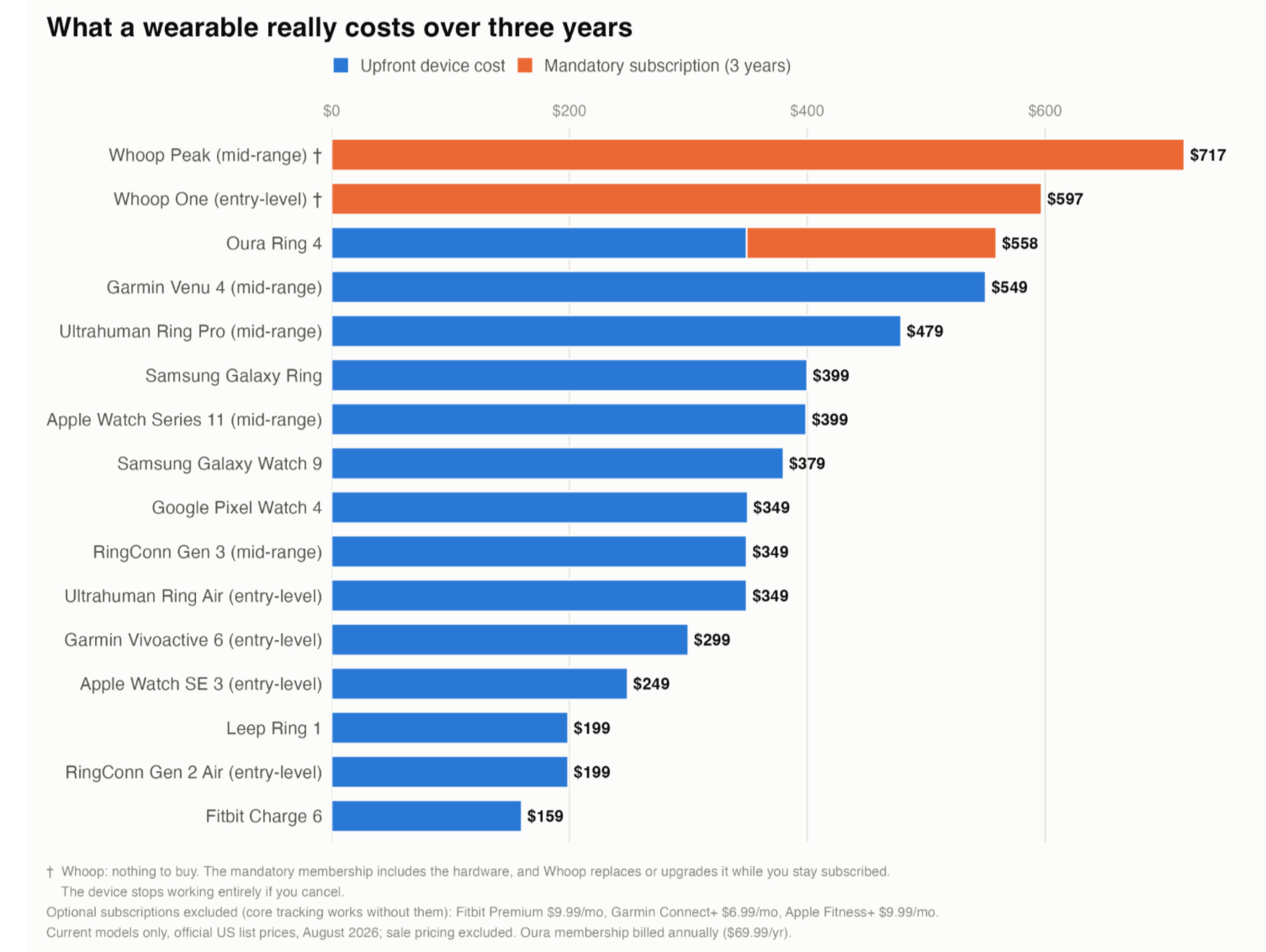
The first thing that stands out on this graph is the cost of Whoop - especially if you get the mid-tier subscription. Over three years, you're paying $717 to keep this device functioning! That said, while it looks like the most expensive device here, and it is, the membership includes the hardware itself. Whoop has released a new generation roughly every three to four years - the Whoop 4.0 arrived in September 2021 and the 5.0 in May 2025 - and members with more than 12 months remaining on their plan get the new hardware at no extra cost. Faulty devices are also replaced while you're subscribed. So over three to four years, you'll likely wear newer hardware than anyone else on this chart, so the price is not quite as bad as it first looks. Mind you, it's still not cheap!
Oura lands in a strange middle ground. The ring itself costs $349, but the $69.99 yearly membership (which you realistically need, as the ring only shows three basic scores without it) adds another $210 over three years. That brings a $349 ring to $558 - more than Garmin's $549 Venu 4, a full-featured mid-range smartwatch. If you consider that an Oura ring will need to be replaced after three years, you're looking at $907 and an ongoing subscription. For that price, you can purchase an Apple Watch Ultra and even Whoop with its $700 subscription works out more affordable.
Then, there are the subscription-free options. Many of these provide a smaller feature set, but they're also slightly to vastly more affordable when you consider the three-year cost of ownership. Here, we see smartwatches and subscription-free rings become the best value picks. Again though, it's important to note that most of the rings will need to be replaced after three years, making both Leep and RingConn options come out to around $400 over that time.
Also worth mentioning are the optional subscriptions. As soon as you add Fitbit Premium, you are looking at $9.99 per month or $99.99 annually. If the features locked behind this plan are important to you, the budget pick based on the graph above will quickly become the sixth most expensive option. Garmin and Apple have similar subscriptions, but Apple's is quite unique in that it's not adding extra device features, but rather unlocking access to a range of at-home workouts and meditations.
Before concluding this section, I want to discuss the combination option because I think it may well be the best. For less than the cost of three years of Whoop, you could buy both a smartwatch and a smart ring outright - an Apple Watch SE 3 ($249) and a Leep Ring 1 ($199) come to $448, saving you $149 against the entry-level Whoop while giving you the best of both worlds: a watch for your wrist during the day, and a comfortable, screenless ring for sleep. I've written before about whether a smart ring can really replace a smartwatch and for many people, the honest answer is that the two work better together. Even if you factor in the price of a replacement ring, you are still coming in at a lower price than the Whoop mid-tier plan.
Why Aren't We Comparing Features?
At this point, you might expect a big feature comparison table. However, I've deliberately avoided one, and I want to quickly explain why. These 16 devices span three very different classes, and their features simply don't map onto each other - a smartwatch's app store and GPS can't be weighed against a ring's two-week battery life in any meaningful way.
Even within a single category, the differences are awkward to score. Among the rings alone, the RingConn Gen 3 offers vibration alerts, the Oura Ring 4 has the most developed app, and Leep ships with a wireless charging case. Among the watches, the Apple Watch Series 11 adds ECG over the SE 3, while Garmin's strength is training depth rather than smart features. A comparison table flattens all of this into misleading equivalence, so I intentionally decided not to add one.
What we can do fairly is compare costs within each category, so you're at least weighing devices built for similar jobs. Here's the same three-year data again, grouped into smart rings, smartwatches, and fitness and recovery trackers.
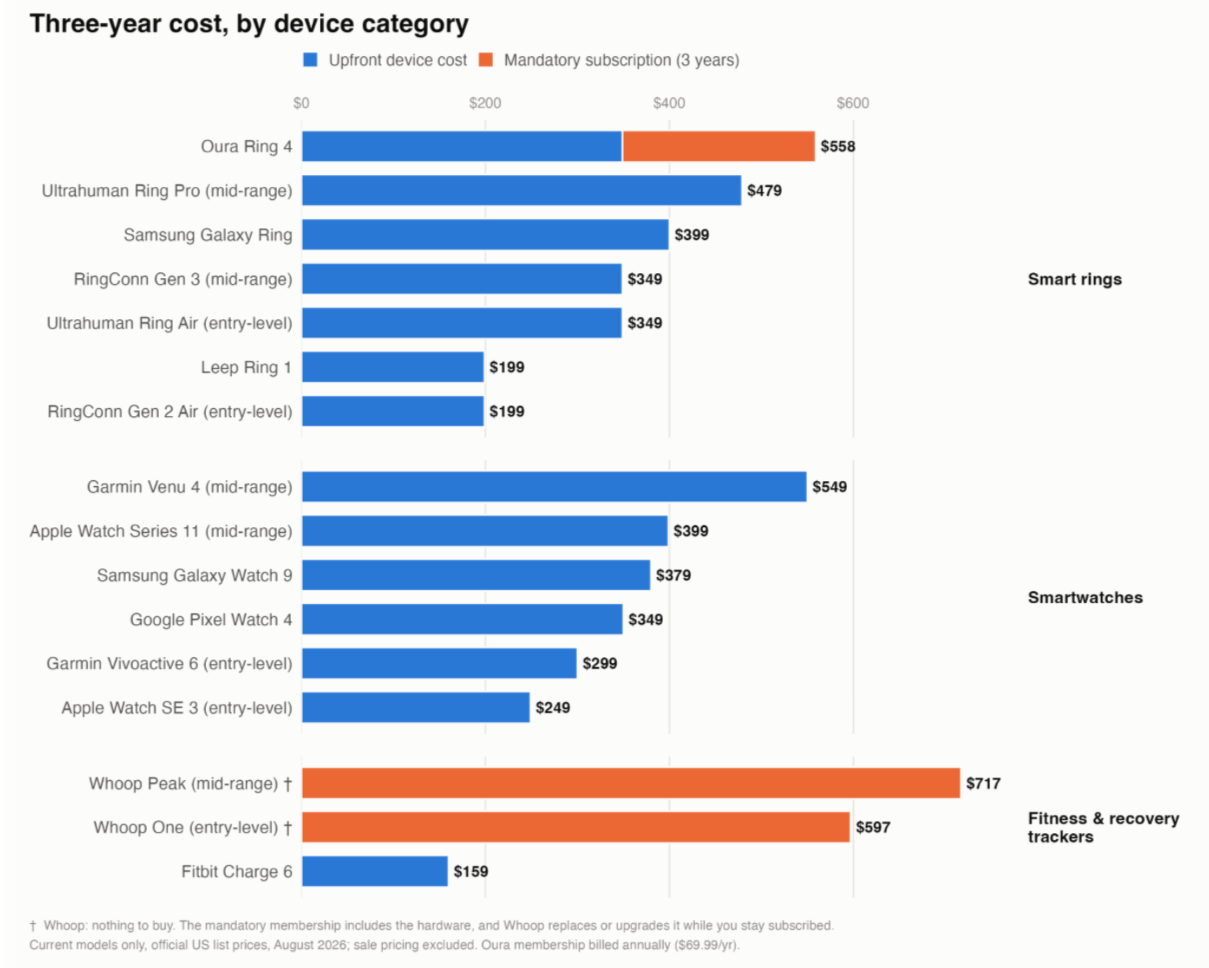
Grouped this way, the ring market tells the most interesting story. The spread runs from $199 to $558 - and the most expensive ring to own isn't the one with the highest price tag. The Oura Ring 4 costs $349 upfront, exactly the same as the RingConn Gen 3 and Ultrahuman Ring Air, yet its membership adds another $209 over three years. Meanwhile, the Leep Ring 1 and RingConn Gen 2 Air deliver the core sleep and recovery experience for $199, subscription free (also, notably, with no optional subscriptions available either).
On the other hand, smartwatches are the most straightforward category: every one of them is a one-off purchase (but many have optional subscriptions), ranging from $249 for the Apple Watch SE 3 to $549 for the Garmin Venu 4, with a crowded middle around $349-$399. What you pay is what it costs. However, this is also the category with the widest range of feature differences. Some devices are fitness-focused trackers with one-week battery life, while some are smart devices that can send messages, receive calls, and need to be charged daily.
Finally, the trackers show the widest gap of all. Three years of Whoop costs $597 to $717 against $159 for the Fitbit Charge 6 - although as I covered earlier, the Whoop figure includes the hardware and likely an upgrade along the way, while the Charge 6 works best if you also pay for a subscription you won't see in this graph.
Another way to make these numbers feel real is to spread them across every day you'd wear the device. Over three years:
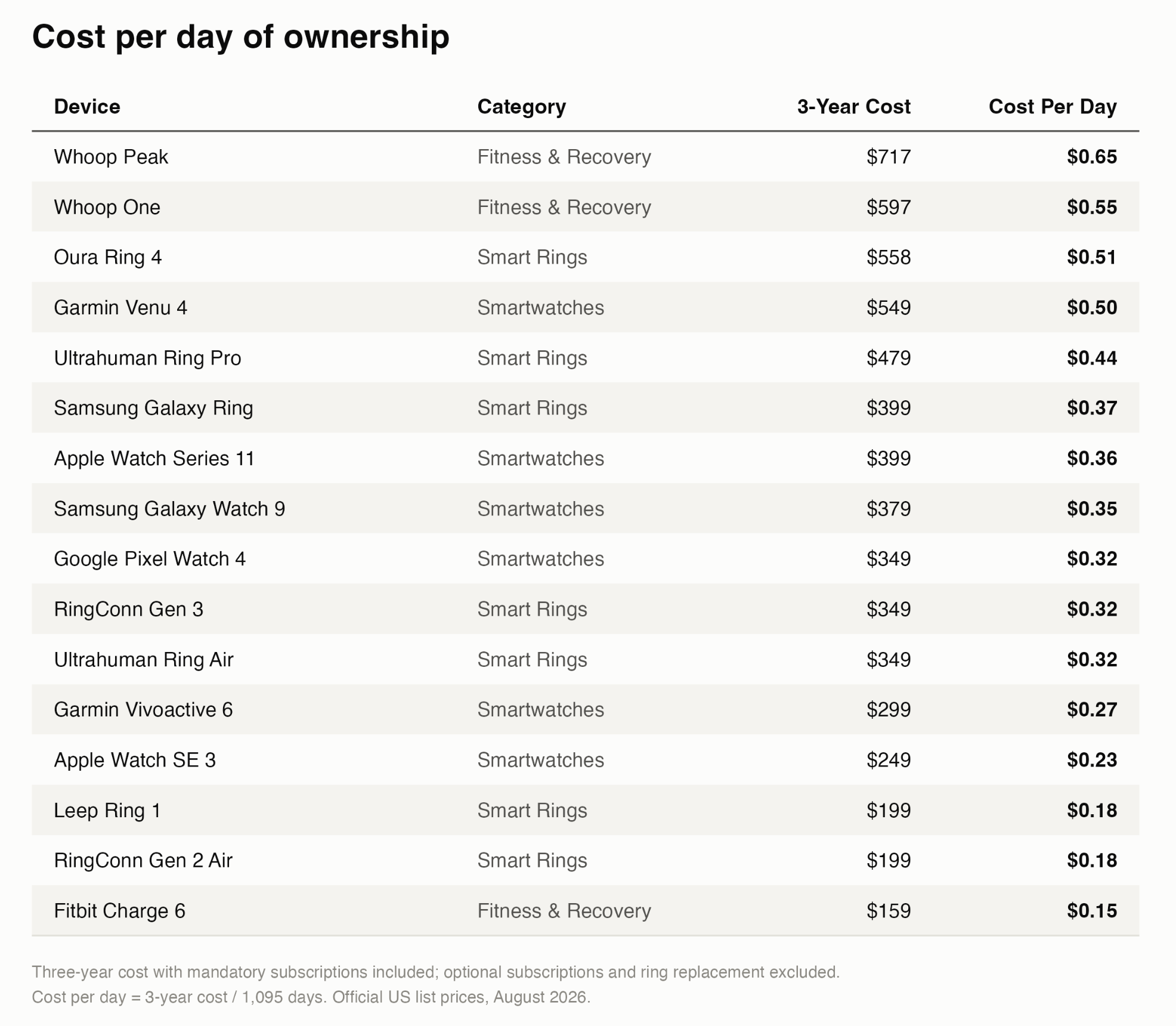
The spread between the cheapest and most expensive device on this list is exactly 50 cents a day. Whether 65 cents a day is a lot for what Whoop offers is a personal call - but it's worth knowing that's the price of the question.
What About the Optional Subscriptions?
Most of the "subscription-free" brands would still quite like a monthly payment from you. Apple offers Fitness+ at $9.99/month or $79.99/year, Garmin has Connect+ at $6.99/month or $69.99/year, and Google sells Fitbit Premium at $9.99/month or $99.99/year for both the Charge 6 and the Pixel Watch 4. None of these are required - core tracking works without them - but they change the three-year picture significantly if you do subscribe.
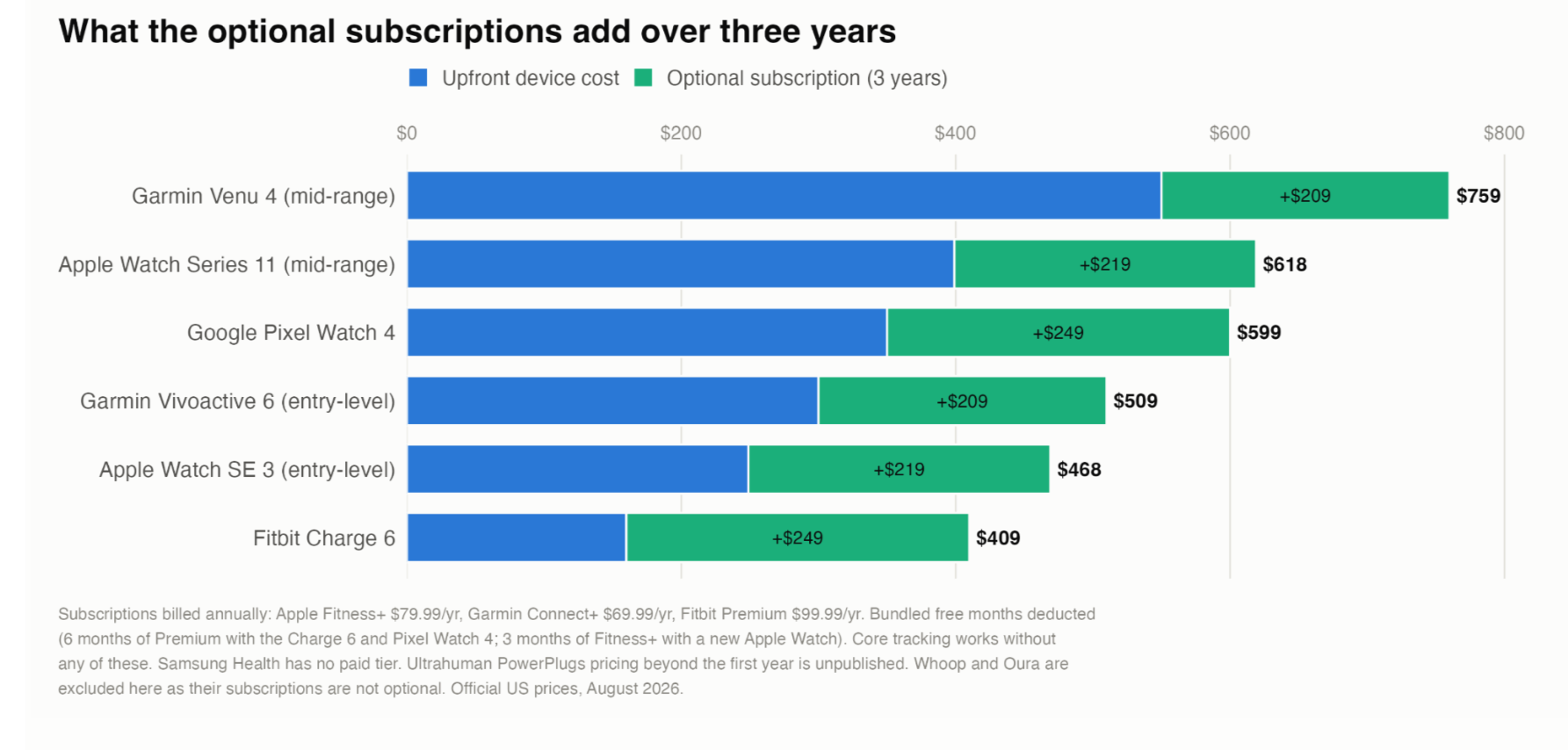
The standout result here is the Garmin Venu 4 with Connect+, which comes to $759 over three years, which makes it more expensive than a Whoop Peak at $717. The "no subscription needed" advantage only exists if you don't subscribe.
These three subscriptions are not equally optional, though. Fitness+ is a workout video service - a true extra that has nothing to do with the watch's tracking. Connect+ currently adds AI-powered insights and little else, and Garmin has publicly committed to keeping all existing tracked data free. Fitbit Premium is the murkiest of the three: the Charge 6 collects the data regardless, but many of the insights built from it sit behind the paywall. Add Premium and the cheapest device in this article climbs to $409 over three years - about the price of owning a Samsung Galaxy Ring outright.
Ultrahuman's PowerPlugs add-ons are free for the first 12 months, but the company hasn't published pricing beyond year one, so I've left them out of the totals. Samsung Health, to its credit, has no paid tier at all.
What Happens After Three Years?
A three-year window is a reasonable benchmark (and, for some reason, the standard comparison that I see), but it's also arbitrary - so I extended the maths to five years. Every device below is drawn exactly as priced, but the rings have had their base purchase prices doubled as it's likely a replacement will be needed within five years.
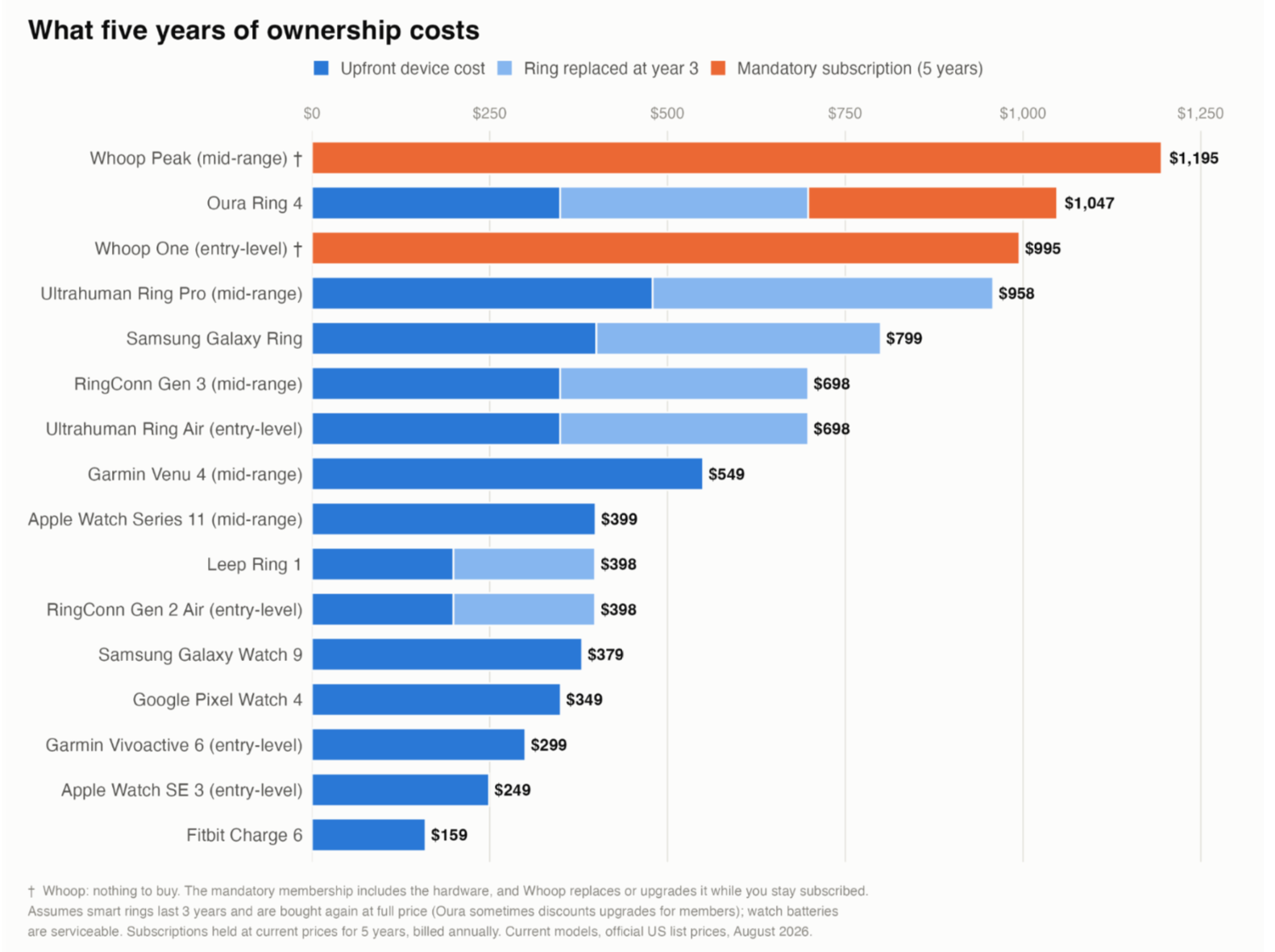
This graph factors in replacement ring costs, but it's worth noting that this wouldn't just be a replacement but is usually an upgrade too. After three years, most rings will have newer models available and, while you will need a replacement due to the irreplaceable batteries, this will also be an upgrade. Furthermore, while watches usually have replaceable batteries, these aren't cheap, and Apple begins pricing at $99 for an Apple Watch replacement battery.
As such, while this graph includes the cost for two rings over the five year duration (because it's disingenuous not to cover this caveat), it's worth noting that it's on what many people would consider a normal tech upgrade cycle. If you'd normally replace your smartwatch after three years, you also need to factor in that cost. Even if you just want the battery replaced, you are likely looking at $99 or more.
Conclusion
Sixteen devices and four graphs later, the pattern is hard to miss: the upfront price and the cost of ownership are two very different numbers. The two devices that cost nothing on day one are the most expensive in this article - $597 and $717 over three years - while the highest sticker price here, the $549 Garmin Venu 4, ends up mid-table over five.
If you want solid tracking for as little as possible, the Fitbit Charge 6 at $159 is unbeatable on paper - just know that many of its insights sit behind a $99.99/year subscription it will regularly remind you about. For $40 more, a $199 ring (the Leep Ring 1 or RingConn Gen 2 Air) tracks sleep and recovery with no paywall at all. Even replaced at year 3, you'll have spent $398 after five years - about a third of the cost of Whoop Peak over the same period.
If you want a full smartwatch, buy-once pricing is still the norm: $249 for the Apple Watch SE 3 if you're on an iPhone, $299 to $379 for the Garmin Vivoactive 6 or Galaxy Watch 9 on Android, and $549 at the top for the Venu 4. What you pay at checkout is what you'll have spent five years later (well, as long as none of these companies introduce mandatory subscriptions).
This doesn't necessarily make Whoop or Oura pricing a rip-off. Whoop's membership includes the hardware and replaces it when a new generation arrives, and Oura's app remains the benchmark for many insights. However, the honest price of those products is 51 to 65 cents for every day you wear them - $995 for five years of Whoop One, $1,047 for five years of Oura with one replacement. If the data is worth that to you, it's a fair trade, but it should be a trade you make knowingly.
As for me - I said at the start that I try to steer clear of subscription devices, and the maths hasn't changed my mind. Pairing a $249 smartwatch with a $199 ring costs $448 outright, $149 less than three years of the cheapest Whoop, and nothing keeps billing you afterwards. That combination is where my money would go.
