

A while back I wrote an article about giving up my Apple Watch as part of a wider digital declutter, but writing it left me sitting with one question I hadn't fully answered at the time: can a smart ring actually replace everything a smartwatch does? Surely not, right? After all, they're so much smaller.
Yet in my case, after a few weeks of swapping, the ring has almost fully replaced the watch. Step counts, sleep data, resting heart rate, all of it comes from a smart ring now, and I don't reach for my watch unless I'm training or working out for something specific. There are times I still need my Apple Watch - for example, when I want to track a gym session - but the ring is the device that I almost never take off. Being a month into ring-only wear, I wanted to loop back to my original question: can a smart ring truly replace a smartwatch?
Now before going further, I want to note that my own experience is with an Apple Watch, which sits at the 'smart' end of the category (which is, by name, already smart!). It essentially wants to be a phone on your wrist, with messaging, apps, payments, and calls built in around the fitness tracking. Something like a Garmin leans the other way, as it's built around training metrics and battery life first, with phone notifications tucked in as a secondary feature.
A lot of what frustrated me about my Apple Watch, the bright screen at night and the constant buzzing, doesn't apply nearly as much to a Garmin. So most of what follows is ring versus smartwatch broadly, not ring versus every kind of watch on the market. I want to share what I've experienced wearing both, and also look at what the science says about which device measures what accurately, because opinion and data don't always point the same way, yet both matter here. Firstly, I want to discuss my initial thoughts and findings after swapping.
What I Instantly Noticed
The first thing I noticed, unsurprisingly, was the size. A ring is small enough that I can slide my hand under the pillow at night without something getting in the way, something the watch never let me do comfortably (it would often get dislodged). The weight difference was also noticeable, but to a lesser degree. A smart ring weighs anywhere from 2 to 8 grams, while an Apple Watch case and band together come in closer to 40. You stop noticing a few grams on a finger before you fall asleep, but you never stop noticing 40 grams pressing into your wrist every time you roll over. The sleep distraction dropped off almost immediately as well, because I no longer had a screen lighting up at 2am when I raised my wrist and no notifications sneaking through what Apple calls 'Priority Mode', which in my experience let more through than I wanted even on the strictest settings.
Perhaps the bigger change, however, was during my working hours. Gloria Mark, who has studied digital attention at UC Irvine for over twenty years, has found that once you're pulled off a task, it takes about 25 and a half minutes on average to fully return to it. A watch buzzing mid-article doesn't just interrupt your flow. It can often totally reset your thoughts. Swapping to the ring made that specific kind of interruption disappear, and I noticed the absence very quickly. As I said in my last article, I missed the data, but I didn't miss the device.
Another big change was the schedule shift. I used to charge the watch every single morning, mostly because I wanted the sleep tracking, which meant it had to stay on my wrist all night and get charged during the day instead. The Apple Watch Series 11, the newest and longest-lasting model, is only rated for 24 hours on a charge, while rings like the Oura Ring 4 and Leep ring last a week or more. With the ring, I only think about charging occasionally now. It's no longer a part of my morning schedule.
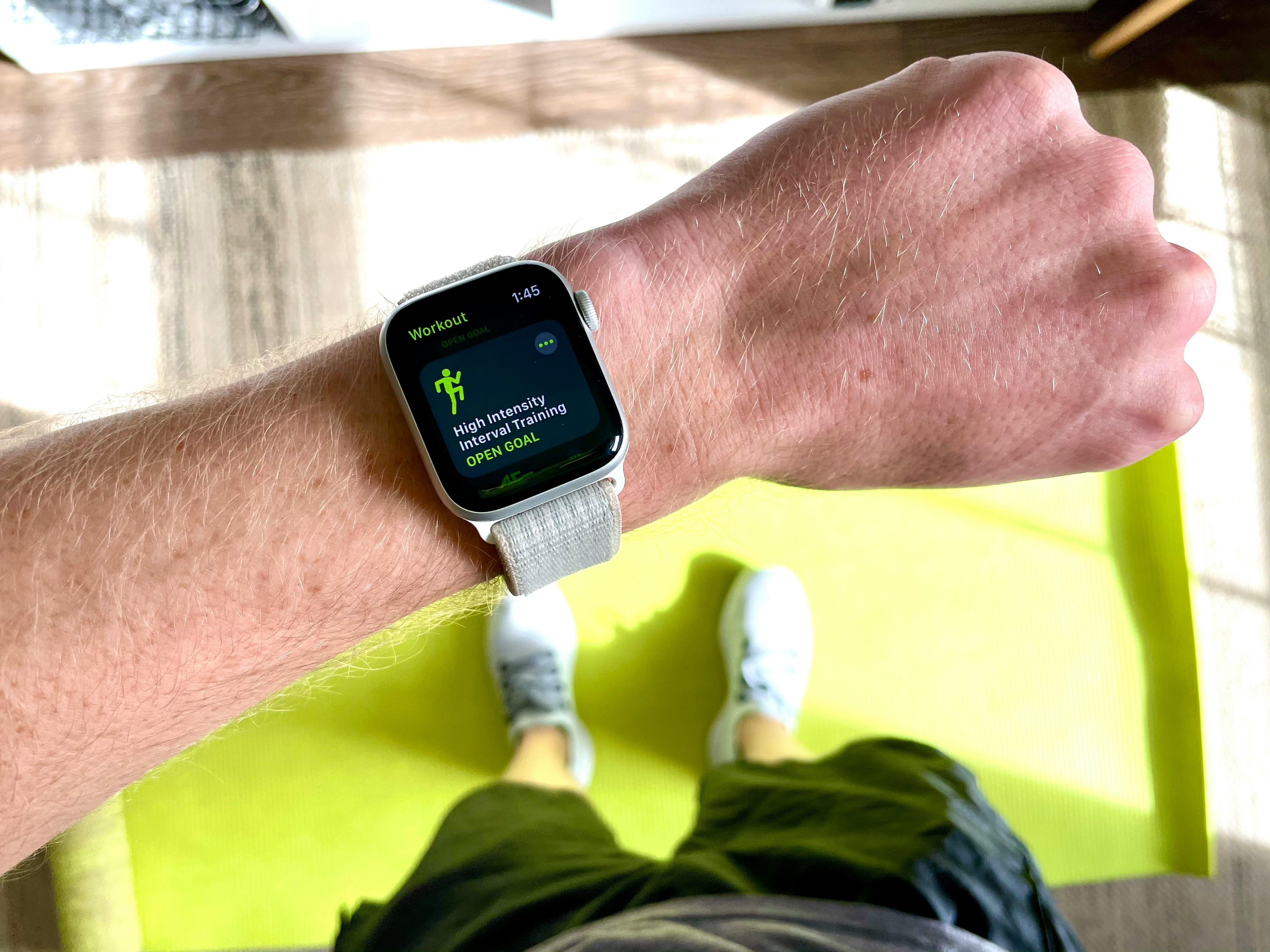
There were downsides too, and I think that there's still a place for the smartwatch. For example, the ring gives you a lot less exercise data. It also can't tell the time, obviously, so I ended up pulling an old analogue watch back out of a drawer just to have something on my wrist during the day. A month in, my read on it is fairly simple. The ring wins for sleep and for living without a screen pulling at your attention all day. The watch still earns its place the moment I'm exercising, or doing something outdoors like diving or mountain biking, where live data on my wrist is helpful to have.
What the Watch Still Does That the Ring Can't
That leads up nicely into the next section, which covers the areas where a smartwatch is still better. As I've already mentioned, smartwatches have a screen and that's the root of nearly everything on this list. A smartwatch like the Apple Watch treats that screen as a small phone; it can show your current pace mid-run, buzz your wrist when a message lands, let you reply without pulling your phone out, and take contactless payments at a register. A cellular model can even make a call or send a text with no phone anywhere nearby. Fall and crash detection call emergency services on their own if you're unresponsive after a hard impact, and there's a single-lead ECG built in that can flag signs of atrial fibrillation from a 30-second reading you take on demand.
There are also somewhat experimental features like blood pressure warnings. Apple Watch doesn't give you a blood pressure number the way a cuff does, and this is very important to keep in mind, but what it has is a hypertension notifications feature that watches for patterns over a 30-day window using the optical heart sensor, and if it spots something consistent with chronic high blood pressure, it flags it and points you toward a real cuff to confirm. It's available on Series 9 and up. A study out of the University of Utah published in JAMA found the alert's predictive value shifts by age and ethnicity, so it functions as a screening tool rather than a medical instrument, meant to supplement a cuff check rather than replace one. Still, no ring on the market attempts anything like it today.
Of course, there's also the exercise gap. Oura rolled out Live Activity Tracking in June 2026, and a ring can now show live pace and distance on your phone's lock screen mid-run, but this is routed through your phone's GPS rather than monitored by the ring itself. Heart rate is another area where smart rings lag behind. A watch still gives you both, pace and heart rate, directly on your wrist, without needing a second device strapped on to make it work. A fitness-first watch like a Garmin goes further still, with sport-specific metrics like ground contact time or dive profiles that neither an Apple Watch nor a ring attempts to track. If you train seriously or spend time somewhere a phone can't easily follow you, that gap is the reason a watch, smart or fitness-focused, still earns a place on your wrist.
The Science: Which One Is Actually More Accurate, and For What
It's all well and good to compare features, but accuracy is just as important. Can smart rings keep up with smartwatches when it comes to data quality?
Let's start with sleep, where the ring actually has the edge. A 2024 study out of Brigham and Women's Hospital, published in Sensors, put the Oura Ring, Fitbit Sense, and Apple Watch against polysomnography, the clinical gold standard that uses electrodes to track brain activity through the night. All three devices were solid at the basic question of whether you were asleep or awake, above 95% sensitivity across the board. Where they split was in identifying which stage of sleep you were in. Oura's deep sleep detection hit a sensitivity of 79.5%, against 50.5% for the Apple Watch, and the watch tended to overestimate both light and deep sleep by close to 45 minutes a night on average. The likely reason comes down to anatomy rather than software, because your finger stays still while you sleep in a way your wrist doesn't (as I mentioned, mine would often loosen when I put my hand under the pillow), and the optical sensors both devices use need steady, consistent contact with skin to read heart rate and movement cleanly.
Resting heart rate and heart rate variability tell a similar story. A 2022 study in the Journal of Medical Internet Research compared a smart ring's overnight readings against a medical-grade ECG chest strap and found low bias between the two when averaged across a full night, though the ring was less precise on some of the finer frequency-domain HRV measures. Overnight, in other words, published studies of specific smart-ring devices have shown good agreement with clinical reference equipment for some overnight metrics, although performance varies by device and metric.
Flip to exercise and the story reverses. A 2026 anatomical placement study testing wrist, forearm, and upper-arm heart rate sensors against a chest strap during rest, warm-up, and high-intensity intervals found accuracy held up fine at rest and during steady effort, then fell off sharply during short, high-motion bursts, with wrist-based readings among the least reliable in those moments. Rings have the same problem, and most don't even try to show live heart rate during a workout because of it. Instead they calculate a rough average after the session ends. If you're doing interval training and actually watching your heart rate in real time to pace yourself, a watch on your wrist, or better yet a strap around your chest or upper arm, is going to serve you better than a ring ever will.
So the honest summary is this. Rings win at night, largely because your finger holds still while you sleep and your wrist doesn't. Exercise flips it, because a watch can hand you live data your legs can actually respond to mid-effort, and a ring is stuck averaging things out after the fact. Neither device is more accurate in some universal sense. They're each better at reading a body that's doing a different thing.
Smart Ring AND Smart Watch?
So, back to the question that started this. Can a ring actually replace everything a watch does? As is usually the case, the answer isn't that straightforward. Both devices excel at different things. Rings are the better choice for sleep and daily tracking, while watches and fitness bands pull ahead during workouts and training sessions.
The good news is that most rings and watches now sync with the same universal health platforms, whichever side you're on. On iPhone that's Apple Health. On Android, Google finally folded things into Health Connect, a single hub that pulls in data from Fitbit, Samsung Health, and most other wearables and apps, after years of Google Fit being the default. This means the devices don't have to compete with each other for the same job. They can genuinely complement one another instead.
Here's where I currently stand. I wear my ring constantly, except while it's charging, and it's my baseline tracker. It covers daily activity, steps, HRV, sleep, and the rest of the basic metrics I check most mornings. My watch spends most of its life on the charger. I wear it for about an hour a day, when I'm exercising, and it stays off the rest of the time partly because I don't want the buzzing and notifications pulling at me during work (and sleep) hours the way they used to. Afterward, everything syncs into Apple Health, so I can see the whole picture in one place.
So here's the final, unsatisfying answer. Both devices have their place, and if you're anything like me, you might be better off buying a more affordable sleep-focused ring (cough, cough, Leep) and pairing it with an affordable smartwatch, rather than sinking a lot more money into one premium device that's trying to do everything at once.
