
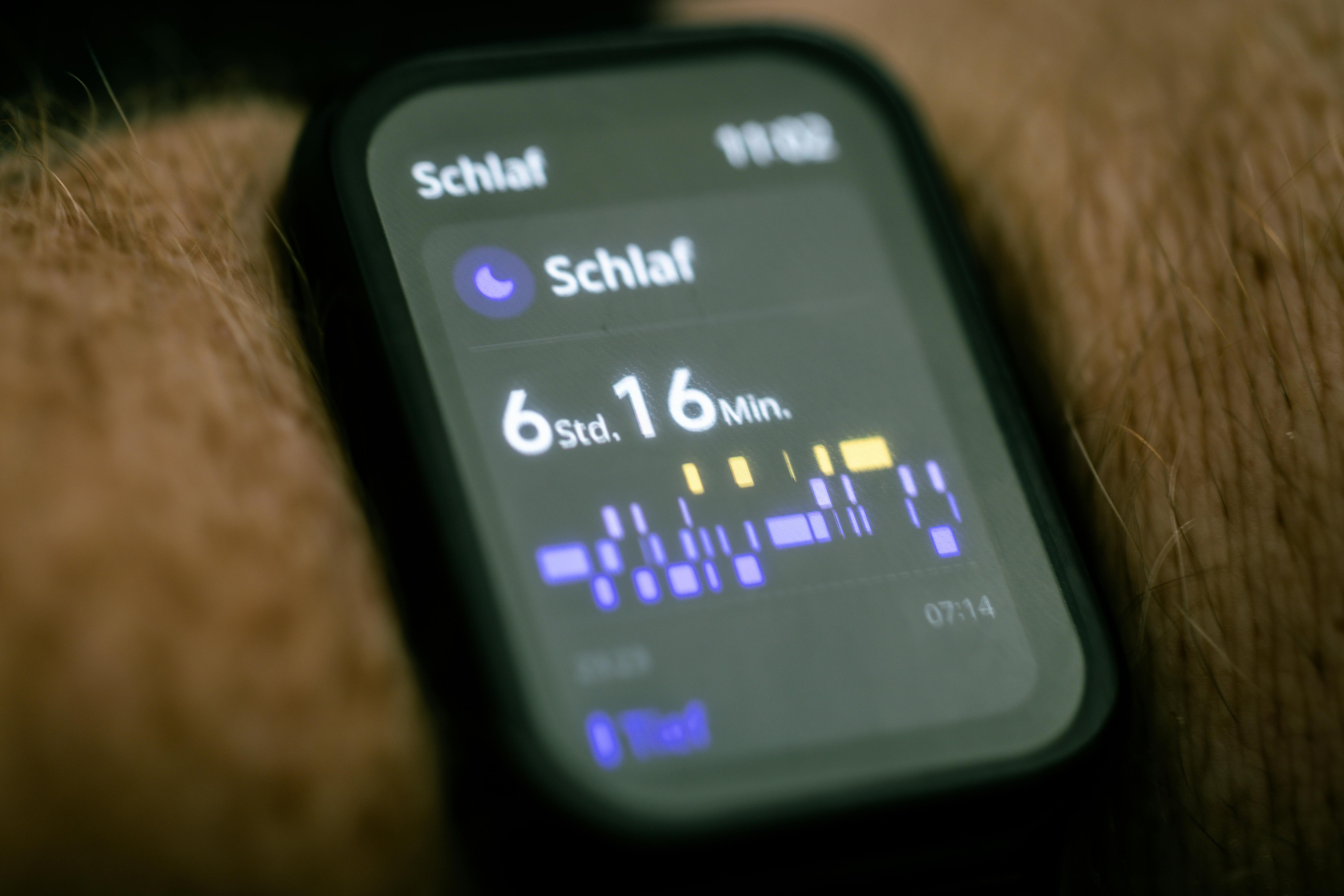

There was a period, not too long ago, where I wanted to track everything. Steps, calories, heart rate, sleep. My idea was pretty clear: more data means more insight, more insight means I can take more actions towards better health. So I strapped on my Apple Watch, went to bed, and woke up the next morning to a score.
67.
I'd slept seven and a half hours and felt fine, but upon seeing the score, I didn't feel fine anymore. What had gone wrong? Was it the late dinner? The episode of ‘Your Friends and Neighbors’ I watched before bed? Over the following week, I started adjusting things. Earlier bedtimes, no screens after nine, sleep supplements. The more I ‘optimised’, the more I lay there thinking about optimising, which is, as it turns out, a terrible way to fall asleep.
If that sounds familiar, you're not alone. Over a third of people who use sleep tracking technology admit to feeling anxious when they receive a poor score, around a quarter say that tracking actually keeps them awake at night (I was in this boat!), and roughly a third have cut back on tracking because of the pressure it creates. Those are figures from Aviva's research into sleep tech habits, and they track with what a lot of people privately describe when you ask them about their relationship with their wearable.
At this point, we’ve built an entire culture around closing rings, hitting targets, and chasing scores. Don’t get me wrong. For some people, it works. But for a meaningful chunk of us, monitoring has quietly become its own source of stress. Another study of 1,002 adults found that while 48% said they learned something useful from their sleep app, only 15% said their sleep actually improved. Around 23% of users aged 18 to 35 said the apps made them stressed about sleep. You can read more about that here.
Now, none of this means sleep tracking is inherently bad. Done well, it can be extremely useful. The problem is that understanding healthy sleep tracking firstly means understanding what often goes wrong, because the problems aren't random. They're baked into the way most tracking products are designed. That’s part of what we wanted to change with Leep.
Why tracking can turn on you
Sleep is strange in one specific way that makes it unlike almost everything else we try to improve. It's a passive process. You can't force it or control it directly, and trying harder doesn't produce better results. It produces the opposite. Most things in life reward effort, but sleep actively punishes it.
The harder you try to sleep, the more alert and aroused you become, and alertness is fundamentally incompatible with falling asleep. This is why insomnia is so self-sustaining. The anxiety about not sleeping is often what keeps you awake, which gives you more to be anxious about, and so the cycle continues.
There's even a clinical name for the extreme end of it. Orthosomnia was coined by researchers at Rush University Medical College and Northwestern University, describing a phenomenon where people become ‘so preoccupied with their sleep tracking data that it ironically causes insomnia’. The original paper was published in the Journal of Clinical Sleep Medicine, and the pattern it described, is something that I’ve personally experienced, and I’m clearly not alone.
Now introduce a nightly score where you’re ‘graded’ into the equation. Suddenly sleep isn't just something that happens, it's something you're being judged on. You wake up and the first thing you do is check your phone. A bad number and the day starts with a low-level sense of failure before you've made coffee. A good number and you feel validated, until the next night when it drops again and you start wondering what you did wrong.
This is where the design of most sleep trackers becomes part of the problem. Scores, rings, streaks, and targets all borrow from the same playbook as fitness apps, and that makes sense for exercise. You can will yourself through another set of squats. You cannot will yourself into REM sleep. Applying a performance framework to something that only works when you stop performing is, at best, a mismatch. At worst, it creates a feedback loop where the monitoring itself becomes the thing disrupting your sleep.
Sleep researchers describe it this way: sleep is like a guest you're inviting to a party. You can create the conditions for it to arrive, but you can't dictate when it shows up. The more desperate you are for it, the more likely it is to stay away. A nightly score doesn't help you create those conditions. It just tells you, each morning, whether the guest came, in a way that makes you more anxious about tomorrow night's invitation.
It doesn't have to work this way. The issue isn't the data, it's the framing.
When tracking actually helps
So far this article reads like a case against sleep trackers, but that's not quite the point. Used well, they can genuinely help. The problem is that "used well" is doing a lot of work in that sentence, and most devices aren't designed with that in mind.
The clearest benefit is awareness. Most people are surprisingly bad at judging their own sleep. They overestimate how long they slept, underestimate how often they woke up, and have no real sense of whether their patterns are consistent from week to week. A tracker gives you a mirror. A survey from the American Academy of Sleep Medicine found that 77% of people who had tried a sleep tracker found it helpful, and 68% said they changed their behaviour based on what they learned. That's from a 2023 AASM survey, and it lines up with what Aviva found too, where 62% of tracker users said they had successfully changed their sleep habits based on insights from their device.
Awareness is, as is often the case, the first step. If you've been going to bed at midnight on weekdays and wondering why you're exhausted by Thursday, seeing that pattern laid out over a few weeks is useful. If you notice that your sleep quality drops every time you drink alcohol, even a glass with dinner, that's the kind of correlation a tracker can surface that you probably wouldn’t catch on feel alone.
In another survey, 42.9% of tracker users said they felt healthier after starting to track their sleep, and 39.3% noticed their energy levels had increased. Those are self-reported figures, so take them with a grain of salt, but they suggest that for a lot of people, the accountability alone is worth something.
The key distinction, and it's one most apps completely ignore, is the difference between tracking trends and tracking nights. A single night's data is not very meaningful. Sleep varies naturally from night to night based on dozens of factors, many of which are completely outside your control. What matters is the pattern across weeks and months: are you consistently getting enough sleep? Is your bedtime drifting later? Are there obvious correlations with how you feel during the day? That's the information that can actually change behaviour.
What good sleep tracking should actually look like
The problem was never the tracking, but rather what the tracking was asking you to do with the information.
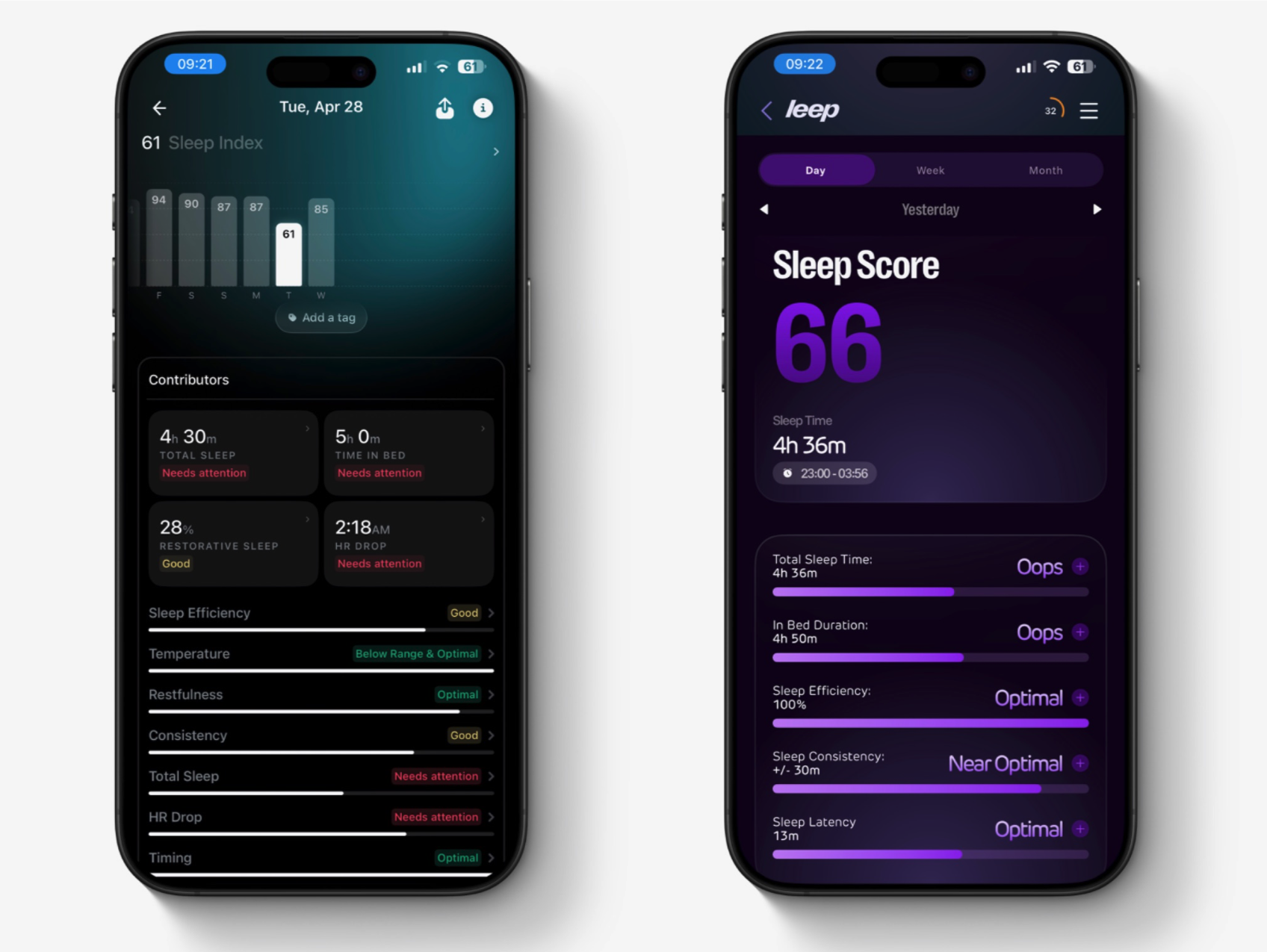
Most devices frame every night as a performance. A bad score arrives with red highlights, warning labels, or prompts telling you something "needs attention." Take Ultrahuman, which flags poor nights with exactly that language. Needs attention. After one bad night. One night that might have been down to a late flight, a stressful day at work, a glass of wine with dinner, or just the natural variation that every human sleep pattern contains. The alarm bells go off regardless, and you start the day already on the back foot.
The Global Wellness Institute has noted that there's a real opportunity for sleep technology to evolve by simplifying how data is presented and shifting focus toward long-term trends. That framing is right, but it's also a polite way of saying that most devices currently do the opposite. They hand you a number every morning, stripped of context, and leave you to draw your own conclusions. For anxious people, those conclusions are rarely kind.
At Leep, we built around a different philosophy. The shorthand we use internally is ‘care not scare, nudge not judge, coach not reproach’. What that means in practice is that Leep still gives you a score, because a score is useful as a quick morning check-in, but it presents it with context rather than alarm. A poor night is acknowledged for what it usually is: a poor night. Not a crisis, not a pattern, not something that needs immediate intervention. Just one data point in a much longer story.
As an example, a recent night produced a poor score for me as I slept only around four and a half hours. But the way Leep presented it reflected something that any sensible friend or GP would tell you: one bad night is normal, it's not your fault, and it doesn't require you to overhaul your routine. Crucially, the sense of judgement just wasn't there. Compare that to the red-flagged "Needs Attention" framing you'd get other devices for the same night, and the difference in how you start your morning is significant.
Good sleep tracking should feel like checking in with something helpful, not bracing for a verdict. The questions worth asking are slow ones: is my sleep timing consistent across the week? Am I getting enough overall? Does anything obvious correlate with worse nights? Those patterns take weeks to emerge, and they're the ones that can actually change behaviour. A score from last Tuesday cannot.
Some experts suggest periodic check-ins rather than nightly monitoring, something like one week per month, to assess changes without feeding anxiety about individual nights. That's a reasonable way to think about it, and it's one Leep's trend view supports. A tracker doesn't need to be used as a daily verdict to be useful.
The goal isn't a perfect score. It's understanding your sleep well enough to stop worrying about it so much.
